Arcade Cashless Payment System: A Guide to More Plays
How an arcade cashless payment system works, why players spend more without coins, and how a no-app phone checkout grows revenue per machine.
An arcade cashless payment system lets a player start a game without coins, tokens or a trip to a change machine. For the operator, it removes the limit that a pocket of quarters puts on every visit. This guide explains how these systems work, why cashless players spend more, and how a checkout on the player's own phone turns a single play into a longer session.
What Is an Arcade Cashless Payment System?
An arcade cashless payment system is the combination of hardware and software that accepts a digital payment and tells a game to start. It replaces or works beside the coin mechanism on claw machines, prize games, kiddie rides, pinball, boxing machines and capsule vending.
Every system has the same three parts. A way for the player to pay, a controller that signals the machine, and a cloud platform where the operator sees sales. The difference between systems is the first part, and it decides how much each player ends up spending.
Arcade is one segment of a wider market. For the full picture across vending, laundry, car wash and kiosks, see our list of the best unattended payment solutions.
Why Cashless Players Spend More
Coins cap the session. A player with four quarters plays four times and leaves, even if the fifth try would have won the prize. A player who pays digitally has no such limit.
The data shows the size of the gap. In amusement machines, cashless payments made up an average of 73% of sales volume in 2022, and the average cashless play purchase was $5.32 against 93 cents for cash, based on reader network data reported by Vending Times. That is more than five times the cash amount per purchase.
The same pattern appears in vending, where the gap is smaller. In 2024 the average cashless vending purchase was $2.24 against $1.78 for cash, according to figures reported by PaymentsJournal. Play is where removing the coin limit pays off most, because the next game is always one more try away.
Four Ways to Go Cashless in an Arcade
Operators have four broad options. They suit different venues, and they ask very different things of the player.
| Approach | How the player pays | Where it fits and where it stops |
|---|---|---|
| Game card system | Buys and loads a venue card at a kiosk or counter, then swipes at each game | Fits large entertainment centers with staff. Needs kiosks, cards and a counter, so it is heavy for route machines |
| Card reader on each game | Taps a bank card or phone on a reader | Fits single machines where one tap is one play. It takes the payment and stops there, with no offers and no loyalty |
| Phone payment with an app | Downloads the provider's app, creates an account, loads a balance, then pays at the machine | Works for regulars who already have the app. A first-time player has to install and register before the first play |
| Phone checkout with no app | Opens a checkout page in the phone's browser at the machine and pays in one tap with a wallet, or scans a card | Fits any machine and any player with a phone. Offers, bundles and loyalty are built in, with nothing to install |
Phone Payment With an App or Without One
Both options put the payment on the player's phone, but they are not the same product. The gap between them is the moment before the first play.
With an app, a new player has to find the app in a store, download it, create an account and load money into a wallet. All of that happens while standing in front of a game that costs a dollar or two. Many players will not do it for one play, and a tourist or a parent passing through a venue almost never will.
With a browser checkout, there is nothing to install and no balance to preload. The player opens the page, sees the offer and pays in one tap with Apple Pay, Google Pay or any other payment method the operator offers. A player who prefers a card can scan it with the phone camera and skip typing the number. There is no friction between wanting to play and playing.
The operator still gets what an app promises, which is a screen to sell bundles, run loyalty and bring players back, without asking for the download first. This is the approach StreamPay is built around, and the rest of this guide focuses on it, because it is the one that changes revenue per machine and not only the way a play is paid for.
How a No-App Phone Checkout Works on a Game
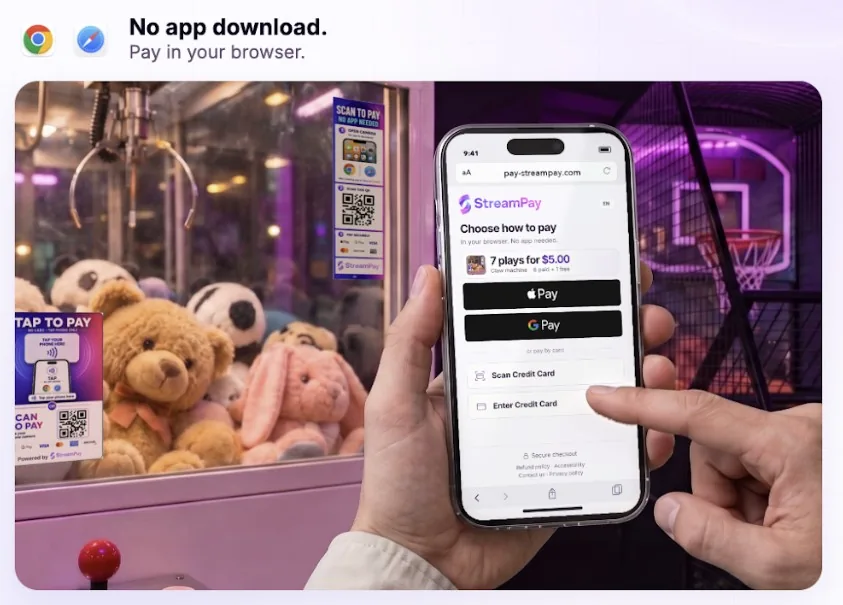
The player points the phone camera at the sticker on the machine. A checkout page opens in the browser. There is no app to download and no account to create. The player picks a number of plays, pays with Apple Pay, Google Pay or a card, and the game starts.
On the machine side, a small controller connects to the same input the coin mechanism uses. Most amusement machines read electrical pulses as coins, so the controller sends the right number of pulses for the plays that were bought. The machine does not need to be replaced or reprogrammed.
Because the checkout is a web page and not a card reader, it works like an online store. That opens options a reader does not have:
- Play bundles. Offer several plays at once, so the player commits to a session before the first try.
- Gamified offers. Show a bonus play or a reward after a set number of games.
- Loyalty and stored value. Let regular players keep a balance and come back to it on the next visit.
- One more try. After a near miss, the next play is a tap away on a phone that is already in the player's hand.
StreamPay builds this checkout. It supports 80+ payment methods and 40+ currencies across 110+ countries, so the same setup serves a venue with tourists and a route that crosses borders. The StreamPay phone checkout kit is the retrofit option for existing games.
In the United States: ArcadePay, Powered by StreamPay
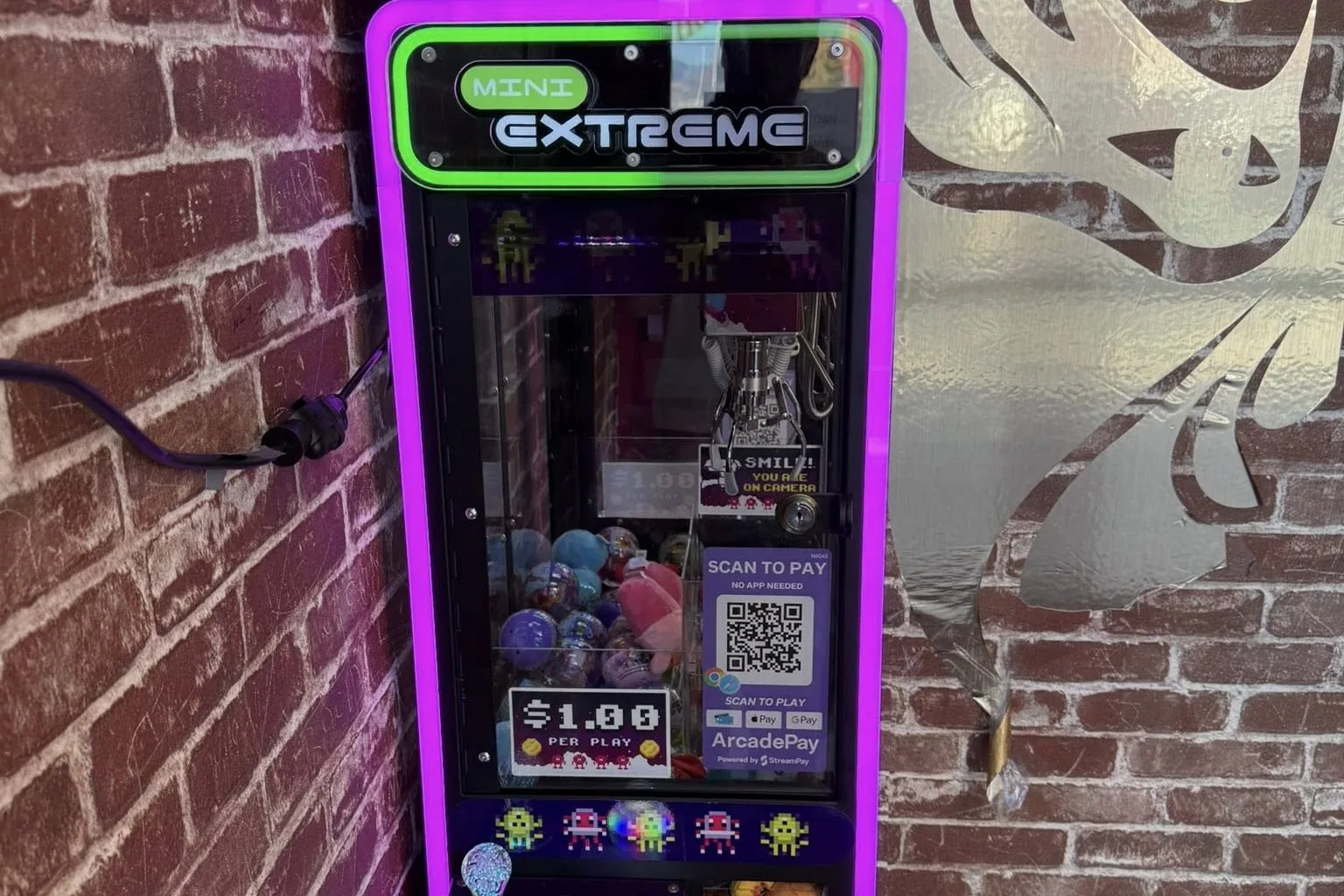
In the United States, arcade and amusement operators work with our partner ArcadePay. ArcadePay brings the product to US operators under its own name, and the checkout and platform behind it are StreamPay's. That is why machines in the field carry a sticker that reads ArcadePay, powered by StreamPay.
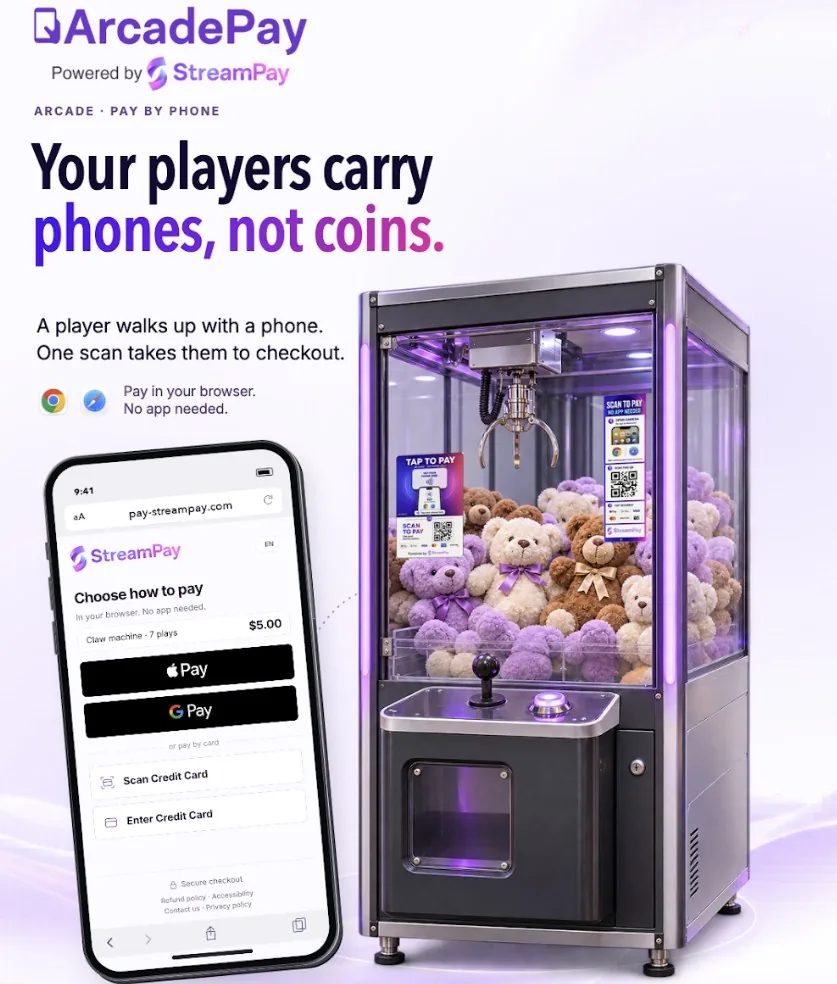
The image above shows what the player sees. A pay sticker on the glass of a claw machine, and a checkout that opens in the phone's browser with the play bundle and the wallet buttons. The coin mechanism still works. The sticker adds a second way to pay for everyone who has a phone and no quarters.
Where to Reach Us: United States and Rest of the World
StreamPay serves arcade and amusement operators around the world. Outside the United States we already work with operators in Canada, Mexico, the UK, Europe and South Africa, and we are expanding to more countries. If yours is not on the list, talk to us anyway.
- United States. Leave your details on the ArcadePay form on our arcade and amusement page, under Talk to the right team. Your inquiry goes to the ArcadePay team.
- Rest of the world. On the same page, choose the Europe and the UK form or the Mexico and Latin America form. For any other country, contact StreamPay directly.
What the Operator Gains
The first gain is revenue per machine. Players who are not limited by coins buy more plays, and bundles raise the amount of each purchase.
The second is labor. Fewer coins means fewer collection trips, less counting and fewer jammed mechanisms. Sales appear in the cloud platform as they happen, so the operator knows which machine earned what without opening a cash box.
The third is visibility across a route. StreamPay's platform adds AI tools on top of the sales data: an operator copilot that answers questions about the fleet, and route planning that cuts wasted visits. A small team can run more machines in more venues.
How to Choose a System
Use these questions when you compare options.
- Does it fit my machines? Check that it supports the pulse interface your games use, and test one machine of each type.
- Does the player need an app or a venue card? Every extra step costs plays. A browser checkout has the fewest steps.
- Can I sell more than one play at a time? Bundles and offers are where the revenue gain comes from.
- Can coins and cashless run side by side? Most operators keep both at first.
- What do I see remotely? Look for sales per machine in real time and alerts when a machine stops earning.
- Who supports me locally? Ask who answers the phone in your country and time zone.
Frequently Asked Questions
Can I add cashless payment to an old claw machine?
Yes, in most cases. If the machine accepts coins through a standard pulse input, a controller can be wired to the same input and send pulses for each paid play. The machine itself stays as it is. Test one unit before you fit a whole route.
Do players need to download an app?
No, not with a browser checkout. The player opens the checkout from the sticker on the machine and pays in one tap with Apple Pay or Google Pay, or scans a card. App-based systems do require a download, an account and a preloaded balance before the first play.
Should I remove the coin mechanism?
No. Keep it. Coins and the phone checkout work side by side, and some players will always prefer cash. Over time you can watch the split per machine and decide where coins are still worth the collection trip.
Is a game card system better than a phone checkout?
It depends on the venue. A game card system suits a large entertainment center with a counter, kiosks and staff. A phone checkout suits street and route machines in venues you do not staff, because it needs no kiosk and no card stock.
How does cashless increase arcade revenue?
It removes the coin limit on each visit. Published reader network data shows the average cashless play purchase at more than five times the cash amount. Bundles and offers in a phone checkout build on that by raising the size of each purchase.
Next Steps
List your machine types, note which venues have good mobile coverage, and pick a few games for a first test. To see the checkout running on a game like yours, book a StreamPay demo or email info@streampay.tech. Operators in the United States will be connected with ArcadePay.
Ready to modernize your unattended fleet?
See how StreamPay unifies payment hardware, machine telemetry, and cloud operations.
or email info@streampay.tech